For small businesses, introducing AI into your business doesn’t mean hiring a data science team or overhauling your entire tech stack. It means finding the right tools, starting small, and building from there, strategically.
The numbers tell a clear story: according to McKinsey’s 2025 State of AI report, 88% of organizations now use AI in at least one business function, up from 55% just two years prior. The businesses that are moving intentionally – not reactively – are the ones capturing real value.
The question isn’t if you should start introducing AI into your business. It’s how to do it without disrupting the operations you’ve worked hard to build.
How to Identify Good AI Opportunities in Your Business
Before purchasing a single tool, start with an audit of your operations. The goal is to find where AI can solve a real problem – not where it sounds impressive.
Look for tasks that are:
- Repetitive and time-consuming (data entry, scheduling, follow-up emails)
- Prone to human error (invoicing, reporting, compliance checklists)
- High-volume with predictable patterns (customer inquiries, onboarding steps)
- Bottlenecks that slow your team down
Ask your team: “What’s the most frustrating part of your day?” The answer is often your best AI opportunity.
The Best Low-Risk Starting Points for AI Adoption
When you’re first introducing AI into your business, start with low-stakes, high-visibility wins. These build team confidence and give you measurable results to point to quickly.
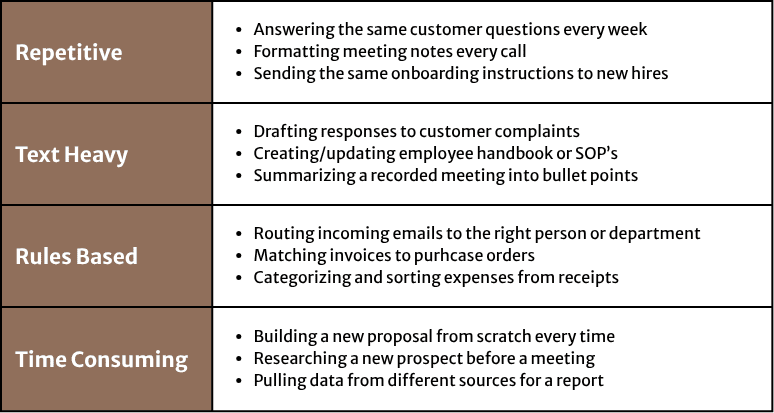
These use cases require minimal training, integrate with tools you likely already use, and deliver results you can see quickly – without touching your core business systems.
How to Train Employees to Use AI Effectively
One of the most common reasons AI implementations stall isn’t the technology – it’s the people. According to BCG research, 46% of employees at organizations undergoing AI-driven change worry about job security. If you don’t address that concern head-on, resistance will quietly undermine your investment.
A 5-Step Employee AI Training Plan
- Communicate the “why” first. Be transparent about what AI will and won’t replace. Employees who understand AI as a tool – not a threat – are far more likely to adopt it.
- Start with the tools they’ll use daily. Don’t train on abstract AI concepts. Train on the specific platform you’re rolling out.
- Create simple use-case guides. Document 3–5 specific ways the team should use the tool in their role.
- Build in practice time. Allow 30–60 minutes per week for supervised, low-pressure exploration.
- Celebrate early wins publicly. When an employee uses AI to save an hour, share that story. It normalizes adoption and builds momentum.
Measuring ROI From AI: What to Track
Here’s the uncomfortable truth about AI ROI: only 25% of AI initiatives deliver their expected return, according to a 2025 IBM global study of 2,000 CEOs. The primary reason? Businesses don’t define what success looks like before they start.
Before you launch any AI tool, establish a baseline for the metric you’re trying to move. Then measure against it consistently.
Key AI ROI metrics to track by category:
- Time savings: Hours per week saved per employee or per department
- Cost reduction: Reduction in labor costs for specific tasks; overhead savings
- Revenue impact: Increase in leads, conversion rates, or customer retention
- Error reduction: Decrease in rework, corrections, or compliance issues
- Employee productivity: Output per person before vs. after implementation
Even a small win – like saving two hours per employee per week – adds up fast.
6 Common AI Implementation Mistakes to Avoid
Most failed AI projects aren’t technology failures — they’re strategy failures. Here’s what to watch for when introducing AI into your business:
- Starting with the tool, not the problem. Don’t buy an AI platform and then look for ways to use it. Start with a specific problem and find the tool that solves it.
- Skipping the data quality check. AI is only as good as the information you feed it. Disorganized, incomplete, or inaccurate data produces bad output — no matter how sophisticated the tool.
- Ignoring change management. Rolling out a tool without communication, training, or buy-in is the fastest way to ensure it collects digital dust.
- Setting unrealistic expectations. AI is a productivity multiplier, not a miracle. Set specific, grounded goals — not “AI will transform everything.”
- Trying to do too much at once. Launching five AI tools simultaneously creates confusion and makes it impossible to measure what’s working.
- Neglecting security and compliance. Ensure any AI tool your team uses meets your data privacy standards — especially if you handle sensitive client or employee information.
The Simple 90-Day AI Roadmap for Small Businesses
You don’t need a six-month planning process to start introducing AI into your business. Here’s a straightforward roadmap to get from zero to measurable results in 90 days.
Phase 1 — Foundation (Days 1–30)
- Audit your current workflows for repetitive, time-consuming tasks
- Survey your team on pain points
- Identify 1–2 low-risk use cases to pilot
- Set baseline metrics for what success looks like
Phase 2 — Rollout (Days 31–60)
- Select and deploy one AI tool for your chosen use case
- Train the relevant team members using the 5-step plan above
- Designate an AI champion to support adoption
- Begin tracking your key metrics weekly
Phase 3 — Scale (Days 61–90)
- Review your baseline vs. current metrics
- Document lessons learned and refine your process
- Decide whether to expand the current tool or add a second use case
- Share results with your team and leadership to build internal confidence
By Day 90, you’ll have real data, real experience, and a repeatable process for scaling AI adoption across more of your business, without the disruption.
The Bottom Line
Introducing AI into your business doesn’t have to be a massive, disruptive project. The businesses winning with AI right now aren’t the ones that moved fastest – they’re the ones that moved smartest. They picked a real problem, started small, trained their people, measured their results, and built from there.
If you missed our webinar – How to Introduce AI Without Disrupting Your Business – you can catch the recording on our YouTube here – How Small Businesses Can Implement AI Without the Overwhelm
Have more questions about this topic? We’re here to help. Contact us for answers, guidance, or support.