
Artificial intelligence has quickly moved from a future technology to a daily business tool. From drafting emails and analyzing spreadsheets to summarizing meetings and generating marketing content, organizations are finding new ways to use AI for business every day.
As adoption grows, many decision makers are asking the same question: Should our business use ChatGPT or Microsoft Copilot?
The answer is more nuanced than most advisors suggest.
Both tools are powered by advanced AI models and can help employees save time, streamline workflows, and improve productivity. However, choosing the right platform isn’t really about determining which AI is “better.”
It’s about determining which AI best fits how YOUR business operates.
Before making a decision, here are the key questions every business leader should consider.
The Quick Comparison
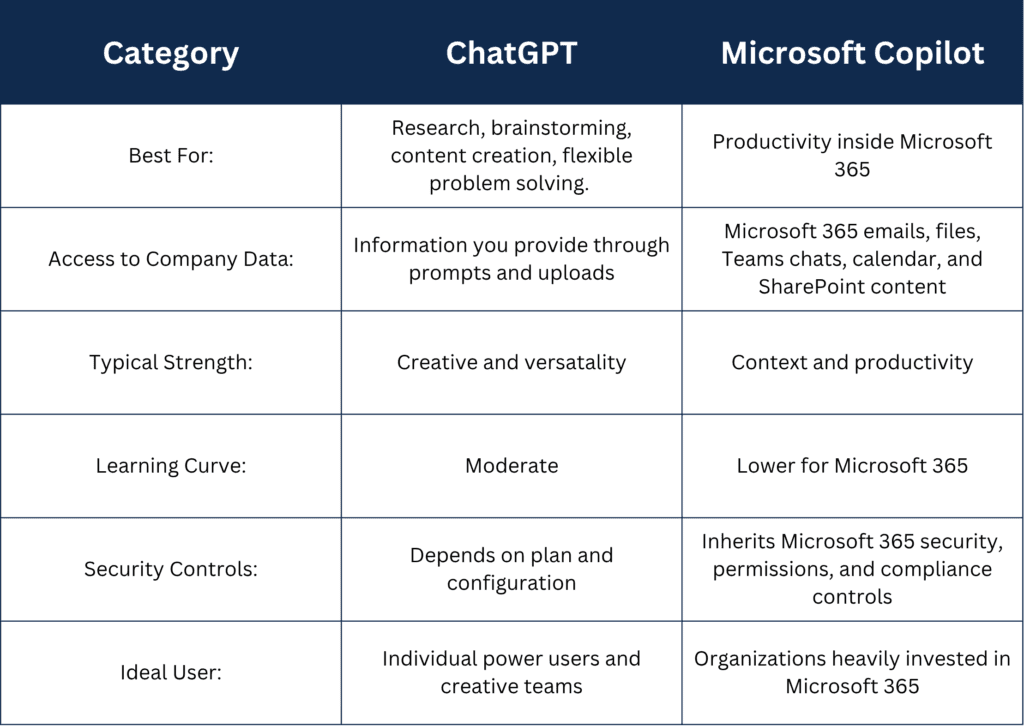
The important takeaway is this: Most businesses shouldn’t choose based on features alone. They should choose based on business needs.
Question #1 – Where Does Your Business Information Live?
For many organizations, this question alone may point toward the right solution.
If your employees spend most of their day in:
- Outlook
- Teams
- SharePoint
- OneDrive
- Word
- Excel
- PowerPoint
Microsoft Copilot has a significant advantage because it can work within the tools employees already use. Imagine asking “Summarize last week’s client meetings.” Or: “Create proposal using the notes that Teams meeting and our pricing document.”
Because Copilot operates within the Microsoft ecosystem, it can leverage existing business context.
ChatGPT, on the other hand, excels when work happens across multiple platforms and information sources. It shines when users want to analyze documents, brainstorm ideas, conduct research, generate content, or solve problems that aren’t tied to a specific business system.
Business takeaway: The more your business lives inside Microsoft 365, the stronger the case for Copilot becomes.
Question #2: Are You Trying to Save Time or Create New Capabilities?
This is where many organizations get stuck.
Some businesses want AI to:
- Reduce administrative work
- Summarize emails
- Create meeting notes
- Find information faster
- Improve productivity
Others want AI to:
- Generate marketing content
- Develop new processes
- Analyze large datasets
- Support innovation initiatives
- Build custom workflows
These are two very different goals.
Copilot Often Excels at Saving Time
Copilot is designed to help users get more value from the tools they’re already using.
Examples include:
- Drafting emails
- Summarizing meetings
- Creating PowerPoint presentations
- Generating Excel insights
- Finding information within company files
ChatGPT Often Excels at Creating New Capabilities
ChatGPT tends to shine when users need:
- Brainstorming assistance
- Content creation
- Research support
- Process development
- Strategic thinking
- Flexible problem solving
If your goal is productivity, Copilot may be the better fit. If your goal is innovation and exploration, ChatGPT often has the advantage.
Question #3: Do You Have Clear Rules for AI Usage?
This may be the most important question. Before choosing ANY AI platform, organizations should establish clear guidelines around:
- What information can employees enter into AI tools?
- How should AI-generated content be reviewed?
- What data is considered sensitive?
- How will AI be used with customer-facing communications?
Many businesses spend months evaluating technology while spending only a few minutes discussing governance.
That’s backwards.
A successful AI for business strategy starts with clear expectations and responsible usage with an AI acceptable use policy.
Remember, AI can accelerate good processes. It can also accelerate bad ones.
Question #4: How Will You Measure Success?
Many organizations purchase AI licenses before defining what success actually looks like.
Before investing, business leaders should ask:
- What problems are we trying to solve?
- How much time are employees spending on repetitive tasks?
- What would justify this investment?
- How will we measure ROI?
Examples of meaningful success metrics include:
- Reducing time spend managing email
- Faster proposal development
- Shorter meeting follow-up times
- Increased employee productivity
- Reduced administrative workload
Without measurable goals, it’s difficult to know whether AI is delivering value.
Question #5: Who Will Champion Adoption?
One of the biggest misconceptions in AI is that simply purchasing licenses will create results.
It won’t.
Successful adoption usually requires someone to:
- Identify use cases
- Train employees
- Share best practices
- Encourage experimentation
- Measure outcomes
Without leadership and ownership, even the best AI platform can struggle to gain traction.
Many businesses discover that the biggest barrier to success isn’t the technology itself.
It’s organizational adoption.
The person leading adoption may have a greater impact on success than the platform you choose.
The Real Winner? It Depends on Your Business
Business leaders often want a simple answer: Which AI platform is better?
The reality is that both tools are extremely capable.
If your organization is heavily invested in Microsoft 365 and you’re focused on productivity, collaboration, and organizational knowledge, Microsoft Copilot may be the natural fit.
If you team values flexibility, research, content creation, brainstorming, and cross-platform workflows, ChatGPT may offer greater versatility.
In many cases, businesses find value in both.
Final Thoughts: Focus on Outcomes, Not Tools
The companies seeing the biggest return from AI for business aren’t necessarily choosing the “best” tool.
They’re asking better questions.
They’re defining goals, establishing guardrails, measuring results, and helping employees adopt new ways of working.
So before asking whether ChatGPT or Copilot is right for your organization, ask yourself: What business problem are you trying to solve?
The answer to that question will often tell you which AI solutions belongs in your business.